AI Is Reshaping Design Roles Faster Than Designers
Key insights
- Mocking and prototyping shrank from 60-70% to 30-40% of a designer's time as engineers now build faster than designers can mock
- Design visions collapsed from 2-5-10 year horizons to 3-6 months because the technology changes too fast to plan further ahead
- AI will improve at taste and judgment, but humans remain essential for decision-making and accountability
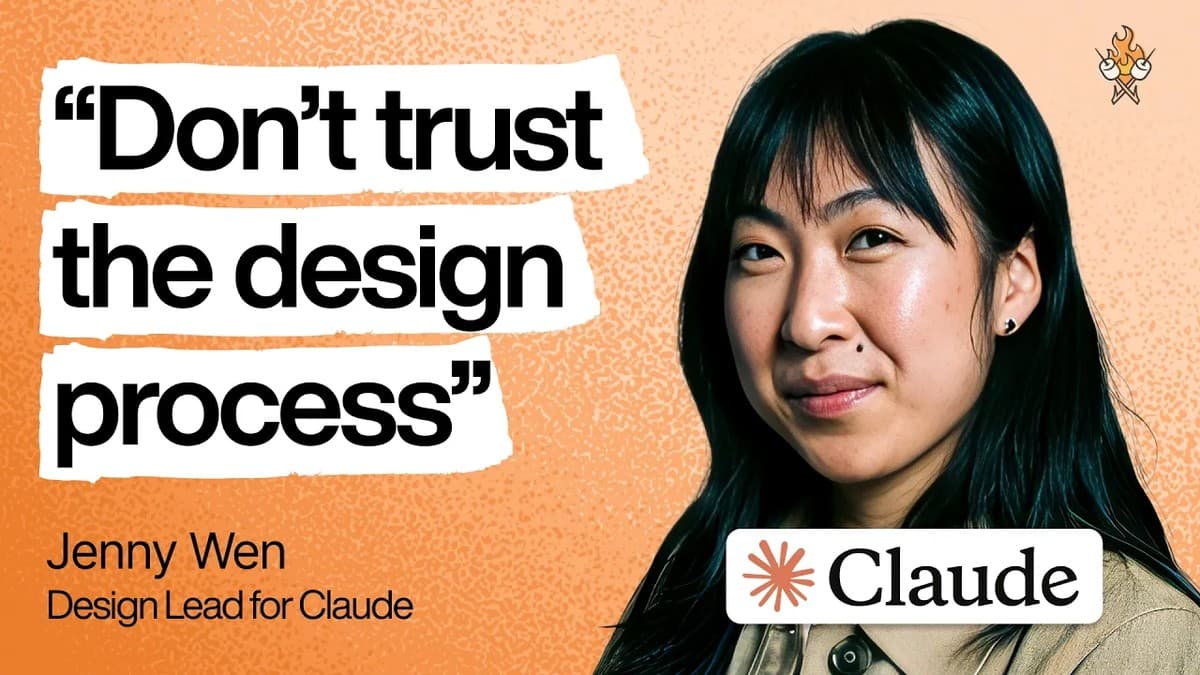
This article is a summary of The design process is dead. Here's what's replacing it. | Jenny Wen (head of design at Claude). Watch the video →
Read this article in norsk
In Brief
Jenny Wen, Head of Design for Claude at Anthropic, joins Lenny Rachitsky to make a blunt claim: the traditional design process of discover, diverge, converge, mock, and iterate is dead. The shift isn't driven by designers choosing to change. It's driven by engineers who now run multiple AI agents at once, shipping features faster than any designer can mock up. Wen argues that design work is splitting into two distinct modes: supporting fast execution and setting short-range vision. The conversation spans how AI is changing what designers do all day, whether AI will develop genuine taste, why chat interfaces are here to stay, and what Anthropic actually looks for when hiring designers today.
The old process is dead
Wen gave a talk at a conference in Berlin in September 2025 called "Don't Trust the Design Process," where she argued that the classic design workflow designers were taught as gospel is gone (5:32). The process she describes is familiar: go off, do research and discovery, diverge, converge, create beautiful mockups, iterate. Designers spent careers learning, teaching, and defending this sequence.
But it was already weakening before AI. Now that engineers can spin up multiple Claude instances and ship features in hours, Wen argues, designers simply cannot keep up by insisting on the old steps. Even her own talk from just months earlier already felt outdated to her (6:11).
Two new types of design work
In Wen's framing, design has split into two distinct modes (6:34):
1. Supporting execution. Engineers build scrappy versions of ideas almost immediately. A designer's role shifts from creating pixel-perfect mockups upfront to consulting, giving feedback, and polishing features alongside engineers as they ship. Wen describes spending part of her day directly in code, doing "last mile" polish work that didn't exist a few months ago.
2. Creating short-range vision. Designers still need to point teams in the same direction. But design visions shrank from 2, 5, or even 10-year horizons to roughly 3 to 6 months (7:32). The technology changes too fast to plan further. And the vision itself no longer needs to be a beautifully story-told deck. Sometimes it's just a prototype that gives people a shared direction.
A day in the life at Anthropic
Wen describes her daily routine as a mix of four activities (13:05). She spends time keeping up with internal developments, reading Slack channels and trying out internal prototypes. She sets aside blocks for forward-looking design work. She jams and consults with engineers, giving feedback on what they've built. And she writes code herself, polishing features directly.
The time allocation has shifted dramatically. Mocking and prototyping used to take 60 to 70% of a designer's time (18:01). Now Wen estimates that's down to 30 to 40%. The freed-up time goes to pairing with engineers (another 30 to 40%) and actual implementation.
Her AI stack
Wen's tool stack is entirely Claude-based (19:01): Claude Chat, Claude Cowork (for longer-running tasks), Claude Code in VS Code (for frontend tweaks), and Claude in Slack (for quick fixes). She describes a workflow where someone mentions a misaligned icon in Slack, tags Claude, and the fix arrives as a pull request (a code change request submitted for review).
Yet Figma still plays a clear role (20:05). Wen uses it specifically for exploring multiple design options at once. Coding tools, she argues, are too linear for divergent exploration. You invest in one direction and iterate on it. Figma lets you throw eight to ten different approaches on a canvas and compare them side by side.
Will AI replace taste and judgment?
Wen's position on AI and taste is more nuanced than the typical defensive response from designers. She admits that designers may be holding on too tightly to the belief that AI can't develop taste (28:32). AI's sense of design quality will get better, she says.
But she draws a different boundary. The hardest parts of building software aren't about building at all. They're about deciding what to build, resolving disagreements between team members, and being accountable for those decisions. AI can weigh in on disputes, but it can't resolve the human politics and judgment calls that shape products.
Wen compares this to radiology: AI may eventually be better at reading scans, but someone still needs to be accountable for the decision (30:55). Asked directly whether Claude could be hired as a designer, Wen says no. It's not yet the strong generalist, the deep specialist, or the talented new graduate. It's good at a first pass and presenting options, but nothing feels "special and hirable yet" (54:01).
Chat interfaces are here to stay
Many predicted that chatbots would be a temporary stop along the journey to more sophisticated AI interfaces. Wen disagrees. Chat opened up infinite ways to work with the model that pre-built interfaces simply cannot match (33:06).
Her prediction is a blend: chat and conversational interfaces will persist alongside more traditional UIs. Anthropic already ships interactive widgets inside Claude's chat (weather, stocks, multiple-choice questions). These widgets get good reception because people still like to click and touch things. But the flexibility of natural language means chat isn't going away. The UIs will increasingly be generated by the models themselves rather than hand-coded by designers.
From director to IC (and back)
Wen left a Director of Design role at Figma, where she managed 12 to 15 designers with managers reporting to her, to join Anthropic as an Individual Contributor (IC) (35:49). The move was partly driven by a question: is middle management safe in the future?
What she found was that the IC year gave her hard skills she wouldn't have gained by managing. The design process changed so much during that period that she believes managers who haven't done hands-on IC work recently can't effectively lead teams (40:01). She compares it to engineering organizations that require new engineering managers to do a rotation building features before they manage.
Claude Cowork: more than 10 days
The viral claim that Claude Cowork shipped in 10 days needs context. Wen clarifies that those 10 days were the sprint from internal prototype to external launch (41:28). The actual exploration period was much longer, with many different prototypes and form factors tested internally. An earlier internal prototype called "Claude Studio" (1:04:02) directly influenced Cowork's design, particularly the way it shows Claude's plan, to-do lists, and the files it's working through.
Three hiring archetypes
When asked what she looks for when hiring designers today, Wen describes three profiles (46:54):
| Archetype | Description | Why it matters now |
|---|---|---|
| Strong generalist ("block-shaped") | 80th percentile good across multiple skills, not just one | The design role is stretching into PM and engineering territory. Generalists flex easily |
| Deep specialist ("deep T") | Top 10% in one specific area, like technical design or visual craft | When anyone can make anything, deep specialists help differentiate products |
| Craft new grad | Early career, humble, eager, wise beyond their years | No baked-in processes to unlearn. Often unburdened by established expectations |
Wen particularly highlights the third archetype as the one most companies overlook. In an era where the role itself is changing fast, someone with a blank slate and fast learning speed can be more valuable than a senior designer stuck in old workflows.
How to interpret these claims
Wen presents a compelling picture of design transformation, but several factors deserve consideration before accepting these conclusions at face value.
The Anthropic context
Wen works at a frontier AI lab where the product is AI. Engineers at Anthropic have access to the most powerful AI coding tools before anyone else. The pace of change she describes, where engineers run seven Claude instances simultaneously (24:17), reflects a bleeding-edge environment. Whether this same dynamic applies at a bank, a healthcare company, or even a non-AI tech company remains an open question. Wen acknowledges this, noting that some parts of the industry pushed back on her Berlin talk, arguing that discovery and traditional process still matter.
Selection bias in the "death" narrative
The claim that the design process is dead comes from someone who chose to leave a comfortable Director role to do IC work at the world's fastest-moving AI lab. Wen is not a typical designer, and Anthropic is not a typical company. The design process may be dying at frontier AI companies while remaining very much alive at companies whose products don't change weekly.
The taste question remains open
Wen's position that AI will get better at taste but humans will remain essential for accountability is reasonable but essentially unfalsifiable today. Two years ago, most people said AI would never write production-quality code. The argument that decision-making and accountability are uniquely human may age the same way.
What would stronger evidence look like?
Wen's observations are based on personal experience at one company. Stronger evidence would include: data from multiple companies at different stages of AI adoption, measurable outcomes (product quality, user satisfaction, revenue) comparing the old process with the new approach, and longitudinal tracking of whether the "execution support" model leads to worse products over time.
Practical implications
For design managers
Wen's strongest advice is direct: if you haven't done hands-on IC work in the current AI era, you likely can't lead effectively (40:01). Consider taking a rotation back into building. She also reframes seemingly low-impact management tasks as potentially the most valuable thing a leader can do (54:54). When Anthropic CPO Mike Krieger submits his own pull requests (56:48), it signals that nothing is beneath a leader and builds team trust.
For individual designers
Start using AI coding tools, even if you don't plan to become technical. The vocabulary of design is shifting toward implementation. Wen's team roasting framework (58:00) also offers a useful lens: psychological safety (where teammates feel comfortable poking fun at each other) combined with high standards creates teams that ship better work faster.
For anyone evaluating ideas
The "legibility framework" from VC Evan Tana at SPC (1:02:00) is worth studying. The most valuable ideas are often illegible (hard to understand or articulate) at first. Wen describes her role partly as spotting these illegible ideas inside Anthropic's internal Slack and prototypes, then translating them into products. Claude Cowork itself emerged from an earlier internal prototype that initially made no sense to her as a designer.
Glossary
| Term | Definition |
|---|---|
| IC (Individual Contributor) | A worker who builds and ships directly, rather than managing other people. In design, this means creating designs, writing code, and polishing features hands-on. |
| Figma | A browser-based design tool used for creating user interfaces, prototypes, and visual designs. It allows multiple designers to work on the same file simultaneously. |
| Claude Cowork | An Anthropic product that extends Claude's chat capabilities to longer-running tasks where Claude can work on your computer and access files. |
| Psychological safety | A team dynamic where members feel safe taking risks, sharing unfinished work, and giving honest feedback without fear of punishment. |
| Design system | A collection of reusable components, patterns, and guidelines that ensure visual and functional consistency across a product. |
| Vibe coding | Using AI to generate software by describing what you want in everyday language instead of writing code manually. |
| Pull request (PR) | A code change submitted for review before it gets merged into the main codebase. The reviewer checks the changes and approves or requests modifications. |
| Non-deterministic | A system that can produce different outputs from the same input. AI models are non-deterministic, which means you can't mock up all possible states of an AI-powered feature. |
| Legibility framework | A 2x2 matrix from VC Evan Tana for evaluating founders and ideas. "Illegible" ideas (hard to understand, on the frontier) may be the most valuable because they haven't been spotted by competitors. |
| Research preview | A product label indicating that a feature is early, experimental, and expected to have rough edges. Used to set expectations while gathering real user feedback. |
Sources and resources
Want to go deeper? Watch the full video on YouTube →