'Skill Up': AI Is Already Taking Jobs
Key insights
- Anthropic's study measures actual AI usage, not just what's theoretically possible, showing a gap between what AI could automate and what it actually does today
- Companies are not firing workers but have reduced hiring of 22-25 year olds by 14% in AI-exposed jobs since ChatGPT launched
- Goldman Sachs' HALO trade shows investors already moving money from knowledge-economy stocks into companies with heavy physical assets
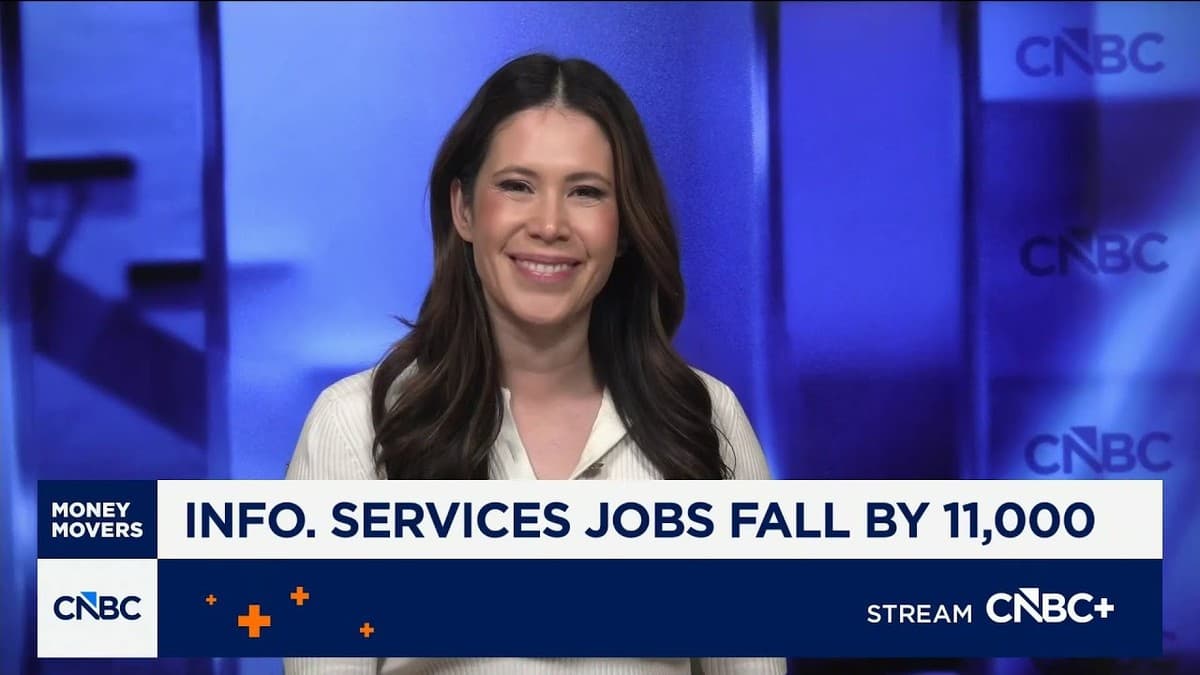
This article is a summary of Early indicator of AI labor impact. Watch the video →
Read this article in norsk
In Brief
Anthropic has published a new study that measures which jobs AI is actually replacing right now, not just which ones it could in theory. The research, reported on CNBC's Money Movers by Deirdre Bosa, shows that programmers already have 75% of their tasks covered by AI, while physical jobs like construction and farming remain almost untouched. The advice from everyone Bosa talked to: "Skill up so that you're valuable." Meanwhile, Goldman Sachs' HALO strategy, which bets on companies with heavy physical assets, has beaten knowledge-economy stocks (companies built on brainwork rather than physical things) by 25 percentage points this year.
What happened
Anthropic released a research paper called "Labor market impacts of AI: A new measure and early evidence" on March 5, 2026 (0:30). Researchers Maxim Massenkoff and Peter McCrory built a new way to measure AI's effect on jobs, called "observed exposure." Instead of guessing what AI could theoretically do, they tracked what it is actually doing in workplaces today.
The key idea: just because AI can do a task doesn't mean anyone is using it that way yet. The study uses Anthropic's own data to see which tasks are genuinely being done by AI. It counts tasks where AI fully replaces the worker more heavily than tasks where AI just helps out (0:35).
The findings show a clear split between desk work and physical work:
| Occupation | AI task coverage |
|---|---|
| Programmers | 75% |
| Customer service reps | 70% |
| Financial analysts | ~60% |
| Construction, farming, transport | Near 0% |
The gap between what AI could do and what it does
One of the study's most striking charts compares what AI could theoretically handle (shown in blue) with what it actually handles today (shown in red) (1:32). Office and admin roles show a huge gap: lots of potential, very little actual AI use so far. The same goes for legal, sales, and finance jobs.
According to Bosa, this gap is the "second wave" waiting to happen. Large companies like Salesforce, Intuit, DocuSign, and Thomson Reuters are already signing AI deals to automate these roles (1:49).
The hidden hiring slowdown
The segment highlights a trend that normal job statistics miss. Hiring of 22 to 25 year olds in jobs where AI is heavily used has dropped 14% since ChatGPT launched (2:10). Unemployment numbers haven't moved because companies aren't firing anyone. They're just not hiring the next generation.
Bosa points out that this is "great for GDP today" because current workers get more done with AI tools. But it creates "a problem for the labor market tomorrow" that won't show up in payroll numbers (2:23).
The data lines up with what Kevin Hassett, a top White House economic advisor, said earlier on CNBC: experienced workers in jobs where AI is heavily used are becoming more productive (1:58). The flip side is fewer entry-level jobs.
So what should young people do? Bosa says the message she hears from everyone is clear: "Use these tools. Get to know them. Skill up so that you're valuable" (3:37).
The HALO trade
This pattern is already showing up in financial markets. Goldman Sachs' HALO basket, short for Heavy Assets, Low Obsolescence, has beaten knowledge-economy stocks by 25 percentage points since the start of 2026 (0:59).
Money is moving away from knowledge-economy companies and toward the physical economy: utilities, infrastructure, transport, and industrial capacity. These are sectors where AI has barely made a dent, making them less vulnerable to disruption.
What we are tracking next
- Whether the "second wave" of AI in office, legal, and finance roles speeds up layoffs or mainly reduces new hiring.
- How policymakers respond to job market changes that normal statistics miss.
- Whether the HALO strategy keeps working as AI gets better at physical-world tasks.
Glossary
| Term | Definition |
|---|---|
| Observed exposure | A new way to measure how much AI is actually being used in specific job tasks, not just how much it theoretically could be. Developed by Anthropic. |
| HALO (Heavy Assets, Low Obsolescence) | A Goldman Sachs strategy that bets on companies whose value comes from physical stuff (factories, pipelines, grids) that's hard to copy and unlikely to be made obsolete by AI. |
| Augmentation vs. automation | Augmentation means AI helps a person do their job better. Automation means AI does the job instead. The Anthropic study counts automation more heavily. |
| Capital-light companies | Businesses built on human knowledge or digital products rather than physical assets. Software companies are a typical example. |
| O*NET | A US government database that breaks down over 800 jobs into specific tasks. Researchers use it to map which tasks AI can take over. |
Sources and resources
Want to go deeper? Watch the full video on YouTube →