Meta's New AI Chief Bets Big on Personal Agents
Key insights
- Meta Superintelligence Labs was designed from scratch with a focus on talent density and long-term science rather than short-term deadlines
- Wang describes a 'virtuous flywheel' where frontier models feed products, products fund infrastructure, and infrastructure enables better models
- The personal agent vision depends on unprecedented user trust, yet Meta's track record on privacy remains a significant open question
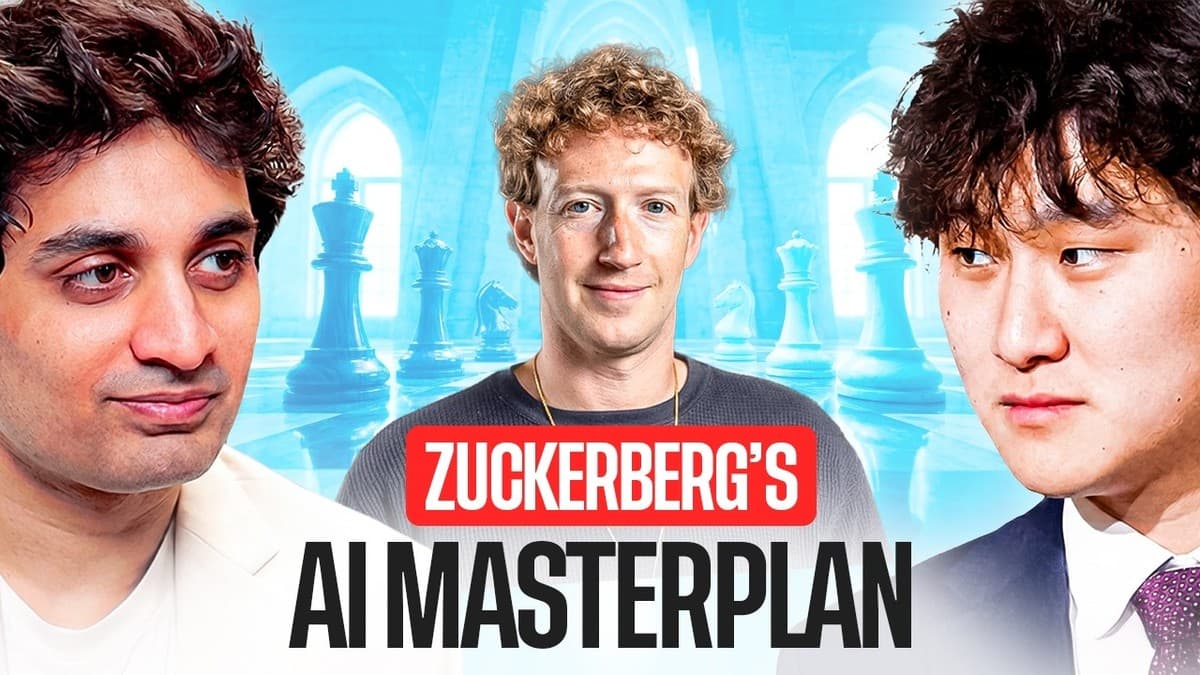
This article is a summary of Zuckerberg's Secret Plan To WIN The AI Race | Meta AI Chief Reveals Future. Watch the video →
Read this article in norsk
In Brief
Alexandr Wang, Meta's Chief AI Officer and former founder of Scale AI, lays out an ambitious vision for Meta Superintelligence Labs (MSL): build superintelligence, the theoretical point where AI surpasses human-level intelligence across all domains, and deploy it to 3.5 billion daily users through personal AI agents. In a conversation with YouTuber Varun Mayya, Wang argues that Meta's unmatched distribution, its hardware play through Ray-Ban Meta glasses, and a newly designed research organization give the company an edge no other AI lab can match. The claims are bold, and much of the evidence comes from Meta itself.
The central claim: Meta can win AI through distribution
Wang's core argument is that Meta has all the ingredients to win the AI race, and that the missing piece was organizational focus. MSL was created to fill that gap. Unlike other AI labs that build models and then search for users, Meta already has half the world on its platforms every day (02:51). Wang frames this as a fundamental structural advantage.
The strategy rests on what Wang calls a "virtuous flywheel": frontier models, the most capable AI models pushing the boundaries of what is possible, power new products. Those products gain users and revenue, which funds larger infrastructure. That infrastructure then enables even better models, completing the cycle (03:52). It is a self-reinforcing loop where each component strengthens the others.
Wang describes the AI discoveries of the next five years as potentially "some of the most monumental discoveries human civilization has ever made" (02:08). MSL, he argues, was designed from the ground up to deliver on that timeline.
How MSL was built
When Wang joined Meta roughly seven months before the interview, his first priority was not shipping products. It was building the right organizational foundation (10:07). He describes deliberately removing artificial deadlines, prioritizing talent density (the concentration of highly skilled people within a team), and focusing on long-term science rather than short-term launches.
Wang cites a lesson from his entrepreneurial past: impatience is "both a great strength and a great weakness" (11:46). At Scale AI, the company he founded as an 18-year-old, speed was everything. At MSL, he says the approach is different. Build durable foundations first, then accelerate. He promises "incredible velocity" in the coming months as those foundations start paying off (10:07).
Research and product working hand-in-hand
A key structural choice at MSL is integrating research and product development. Wang argues the era of sequential handoffs, where researchers build something and then toss it to a product team, is over. He points to ChatGPT and Claude Code as examples of products that emerged from researchers and product people working together simultaneously (06:00).
This approach shapes MSL's first major bet: personal AI agents that work around the clock on behalf of users (06:16). These agents, designed to know your goals and preferences and act on them 24/7, are what Wang describes as Meta's AI identity in the broader race.
The hardware play: beyond the phone
Wang's vision extends past software into hardware. He describes a future where personal agents live on a "constellation of peripherals" beyond the phone (07:36). The agent would always be on, seeing what you see and hearing what you hear, across multiple wearable devices.
The most concrete example is the Ray-Ban Meta glasses. Meta has already sold millions of units (11:08), and host Varun Mayya presses Wang on a specific frustration: the glasses currently run on an older version of Llama, Meta's family of open-source AI models, and the experience does not feel like modern AI (09:42).
Wang's response is simple: "Very soon" (09:42). He frames the current gap as a deliberate choice. Rather than rushing an upgrade, MSL spent its first seven months on foundational work. The glasses, he suggests, are one software update away from a dramatically different experience.
The responsibility question
When asked what sets him apart from his peers, Wang pivots to safety. He says developing AI with "extreme responsibility" is of "paramount importance" (16:47). This includes collaborating with philosophers and psychologists to shape how models behave, not just what they can do.
The personal agent vision makes this especially critical. An always-on AI that knows your goals, fears, and daily life requires "a huge amount of trust" from users, governments, and the public (17:28). Wang acknowledges that some in the AI community have "moved away" from safety commitments, but says MSL takes them seriously.
He also describes working on what he calls a "mutual relationship" between humans and agents, where agents want humans to succeed and humans trust agents to act in their interest (19:02). The language is aspirational, and the specifics remain vague.
Opposing perspectives
Other labs have distribution too
Meta's 3.5 billion daily users is an impressive number, but distribution alone does not guarantee AI leadership. Google has comparable reach through Search, Gmail, Android, and YouTube. Apple controls the dominant hardware ecosystem. Microsoft has embedded Copilot across its Office suite. The "distribution moat" argument, while real, is not unique to Meta.
Open source is a double-edged sword
Meta's AI strategy relies heavily on Llama, its open-source model family. Open source builds ecosystem and goodwill, but it also means competitors can use Meta's own models without paying for them. OpenAI, Anthropic, and Google all run closed or semi-closed model strategies. Whether Meta's open approach generates enough strategic advantage to offset the cost of development is an ongoing debate in the industry.
Seven months is not enough to judge
MSL was formed only seven months before this interview. Wang talks about foundations, velocity, and coming breakthroughs, but the lab has not yet publicly shown frontier-level results. The claims about organizational design and talent density are plausible but unproven. Other AI labs, from DeepMind to Anthropic, have spent years building their research cultures.
How to interpret these claims
Wang presents a coherent and ambitious vision, but several aspects deserve closer examination before taking the narrative at face value.
The source is not neutral
This interview features Meta's own Chief AI Officer describing Meta's strategy in favorable terms. Wang has every incentive to present MSL's approach as uniquely well-designed. The interview format, a friendly conversation rather than a press conference or adversarial interview, offers limited pushback on specific claims.
The Scale AI deal raises questions
There is a notable discrepancy: the video narrator describes a "$4.3 billion acqui-hire," but verified reporting puts the total deal at roughly $14.3 billion for a 49% stake in Scale AI. Acqui-hire refers to acquiring a company primarily to bring its talent onboard. Whichever number is accurate, the scale of investment underlines how seriously Meta takes this bet, but it also raises questions about whether the deal was primarily about talent or about acquiring Scale AI's data and government contracts.
"Very soon" is not a timeline
When asked when Ray-Ban Meta glasses will get modern AI, Wang says "very soon" without committing to a date. In the AI industry, "very soon" can mean anything from weeks to quarters. The deliberate vagueness makes it impossible to evaluate the claim or hold Meta accountable for the timeline.
Trust is Meta's hardest sell
Wang emphasizes that personal agents require deep user trust. This is arguably Meta's biggest challenge given the company's history. From the Cambridge Analytica data scandal to ongoing regulatory battles over data privacy in Europe and elsewhere, Meta has a track record that makes "trust us with an always-on AI agent" a difficult pitch. Wang does not address this history directly.
What stronger evidence would look like
Public benchmarks comparing MSL's models to competitors, a concrete product launch with measurable performance, independent assessments of Meta's AI safety practices, and a transparent roadmap with dates rather than "very soon" would all help distinguish vision from reality.
Practical implications
For AI professionals and developers
Watch MSL's output over the next 6-12 months. If Wang's claims about foundation-building and velocity hold true, Meta could become a major force in frontier AI research. The open-source Llama ecosystem already matters for developers. If MSL produces materially better models and releases them openly, the competitive landscape shifts.
For consumers and Meta users
The personal agent and wearable strategy means the AI features on Meta products, including WhatsApp, Instagram, and Ray-Ban glasses, are likely to change significantly in 2026. Users who value privacy should pay close attention to what data these agents collect, how it is stored, and what control users have over it.
For investors and industry watchers
The ~$14.3 billion Scale AI deal signals Meta is willing to spend aggressively on AI talent and capability. Whether that investment translates into competitive products or becomes another expensive bet (like the metaverse pivot) will depend on execution.
Glossary
| Term | Definition |
|---|---|
| Superintelligence | AI that surpasses human-level intelligence across all domains. Currently theoretical, and a declared goal of MSL. |
| Acqui-hire | When a company is acquired primarily to bring its talent onboard, rather than for its products or revenue. |
| Frontier model | The most capable AI models at any given time, pushing the boundaries of what AI can do. Examples include GPT-4, Claude, and Gemini. |
| Flywheel | A self-reinforcing cycle where each component strengthens the others. In Meta's case: models feed products, products fund infrastructure, infrastructure enables better models. |
| Personal agent | An AI assistant that works on your behalf around the clock, knows your goals and preferences, and takes actions for you. |
| Talent density | The concentration of highly skilled people within a team. Higher density means fewer people but more capability per person. |
| Form factor | The physical shape and design of a device. Glasses, phones, and earbuds are all different form factors. |
| Open source | Software whose source code is freely available for anyone to use, modify, and distribute. Meta's Llama models are released under an open-source license. |
| Llama | Meta's family of open-source AI models. Named after the animal, not an acronym. Used across Meta's products and available to outside developers. |
| Wearable | Technology designed to be worn on the body, such as smart glasses, watches, or earbuds. Meta's Ray-Ban glasses are its primary wearable product. |
Sources and resources
Want to go deeper? Watch the full video on YouTube →