The Activists Disabling Waymo's Driverless Taxis
Key insights
- Half of Waymo's miles in San Francisco are driven without passengers, adding congestion and environmental cost
- Safe Street Rebel disables robotaxis with painter's tape, claiming no law prohibits it
- San Francisco residents had no democratic vote on deploying 2,500 autonomous vehicles in their city
This article is a summary of The driverless taxis taking over San Francisco - BBC. Watch the video →
Read this article in norsk
In Brief
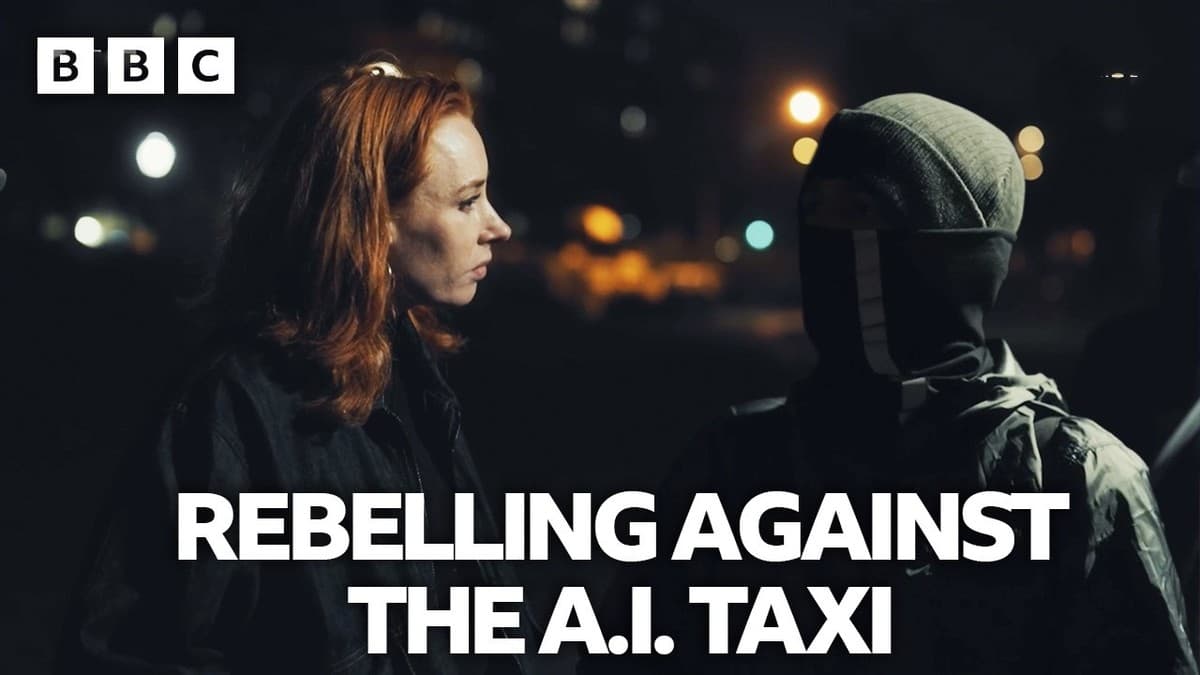
Waymo, a subsidiary of Alphabet (Google's parent company), has deployed roughly 2,500 driverless taxis across U.S. cities. In this clip from BBC's AI Confidential, presenter Hannah Fry meets Safe Street Rebel, an anonymous activist group in San Francisco that disables the robotaxis using painter's tape. The group argues the cars add congestion, operate above the law, and were deployed without any public vote. Fry's own observation raises a question that goes beyond protest: if half the cars on the road are driving empty, who exactly is this technology serving?
The case against Waymo
Safe Street Rebel's objections are practical, not philosophical. The group takes issue with Waymo positioning itself as "the future of public transit" when, in their view, the service is just a taxi where you don't talk to someone (0:42).
Their core complaints center on three points. First, an estimated 50% of miles driven have no passengers inside (0:47). When a car is not parked, it continues circling the city waiting for its next ride, a practice known in the industry as "deadheading" (driving empty between fares). Second, the cars reportedly cannot be ticketed for any moving violations (1:05). The group claims to have videos of Waymo vehicles driving 40 mph on the wrong side of the road with no legal consequences (1:10). Third, unlike a human Uber or Lyft driver who follows the same traffic rules as everyone else, these cars are described as "completely immune" (1:10).
Painter's tape and civil disobedience
To express their frustration, the group goes around San Francisco disabling Waymo vehicles (1:24). The BBC was not permitted to show exactly how they do it, but the method involves painter's tape placed over the car's sensors: no damage, no residue (1:24). The disabled car stops in the road, blocking other autonomous vehicles behind it. During filming, Fry watches a chain reaction unfold: one taped car blocks a second Waymo, then a third arrives and is stuck too. A human driver behind them simply goes around the problem (2:22).
Bystanders on the sidewalk cheered the activists on (2:09).
The group claims what they do is not illegal. "We can't find any law that it breaks. It's not vandalism," one member tells Fry (2:44). The group was previously known for "coning," a tactic where traffic cones were placed on the cars' sensors.
The democratic deficit
When Fry asks whether there are more democratic ways to address the issue, the answer is pointed: "It would be nice if we could vote" (3:00). No public referendum preceded the deployment of 2,500 autonomous vehicles on San Francisco's streets. The residents were not consulted.
Fry presses further: "Does it feel like something that has happened to you rather than with you?" The response is immediate: "Absolutely" (3:08).
Hannah Fry's reflection
After the activists leave, Fry shares her own observations. The cars, she notes, are "surprisingly easy to bully" (3:26). But what struck her most was how many of the Waymo vehicles passing by were empty. "Hardly any of them have people inside" (3:30).
This leads to her central reflection. The rebels raised a point she had not previously considered: the environmental cost of empty circling. Beyond congestion, these cars need to be powered. "They got to be powered," Fry observes (3:52). Whether electric or otherwise, empty vehicles driving continuously through a city carry an energy cost that is easy to overlook when the marketing focuses on safety and convenience.
How to interpret this
This is a four-minute documentary clip featuring one activist group and one presenter's observations. It is not a comprehensive assessment of autonomous vehicle policy. Several things are worth considering:
The 50% claim needs context. Safe Street Rebel states that half of Waymo's miles are driven without passengers. This is a significant claim, but the clip provides no source for the figure. Waymo's own data may tell a different story. Deadheading is a real phenomenon in ride-hailing, but the exact percentage matters for any serious policy argument.
Legal immunity is more nuanced than presented. The claim that Waymo cars "cannot be ticketed" for moving violations deserves investigation. Autonomous vehicle regulation in California has been evolving rapidly, and the legal framework governing traffic enforcement for driverless vehicles is more complex than a blanket statement of immunity suggests.
The democratic argument resonates but has limits. Many urban infrastructure decisions are made without direct public votes. Bus routes, bike lanes, and ride-share regulations are typically decided by city councils and regulatory agencies. The question is whether autonomous vehicles represent something categorically different that warrants direct democratic input, or whether existing regulatory processes should suffice.
Tape as protest is symbolic. Safe Street Rebel's method is nondestructive and temporary. But disabling vehicles on public roads creates its own safety concerns. A stopped car blocking traffic could delay emergency vehicles or create hazards for cyclists and pedestrians. The activists frame their actions as harmless, but the downstream effects are worth examining.
Glossary
| Term | Definition |
|---|---|
| Waymo | Autonomous vehicle company owned by Alphabet (Google's parent company), operating robotaxi services in several U.S. cities. |
| Robotaxi | A self-driving taxi that operates without a human driver, using sensors and AI to navigate roads. |
| Deadheading | When a ride-hail vehicle drives without passengers between fares, consuming energy and road space without serving anyone. |
| Autonomous vehicle (AV) | A vehicle that can drive itself using sensors, cameras, and artificial intelligence without human control. |
| Safe Street Rebel | An anonymous activist group in San Francisco that opposes the deployment of autonomous vehicles on public streets. |
| LiDAR | "Light Detection and Ranging," a sensor technology that uses laser pulses to create a 3D map of a car's surroundings. Key sensor on most autonomous vehicles. |
| Coning | A protest tactic where traffic cones are placed on a self-driving car's sensors to disable it. Popularized by Safe Street Rebel. |
| Civil disobedience | Deliberately breaking or circumventing rules as a form of nonviolent protest, typically to draw attention to a perceived injustice. |
Sources and resources
Want to go deeper? Watch the full video on YouTube →